Sports Are Not Just Games for Children… Sometimes They Become Therapy
Why children need sports not only for fitness, but also for emotional balance, confidence, focus, and handling life in a healthier way.
By Shwetha B R | 07, May, 2026 07:19 AM
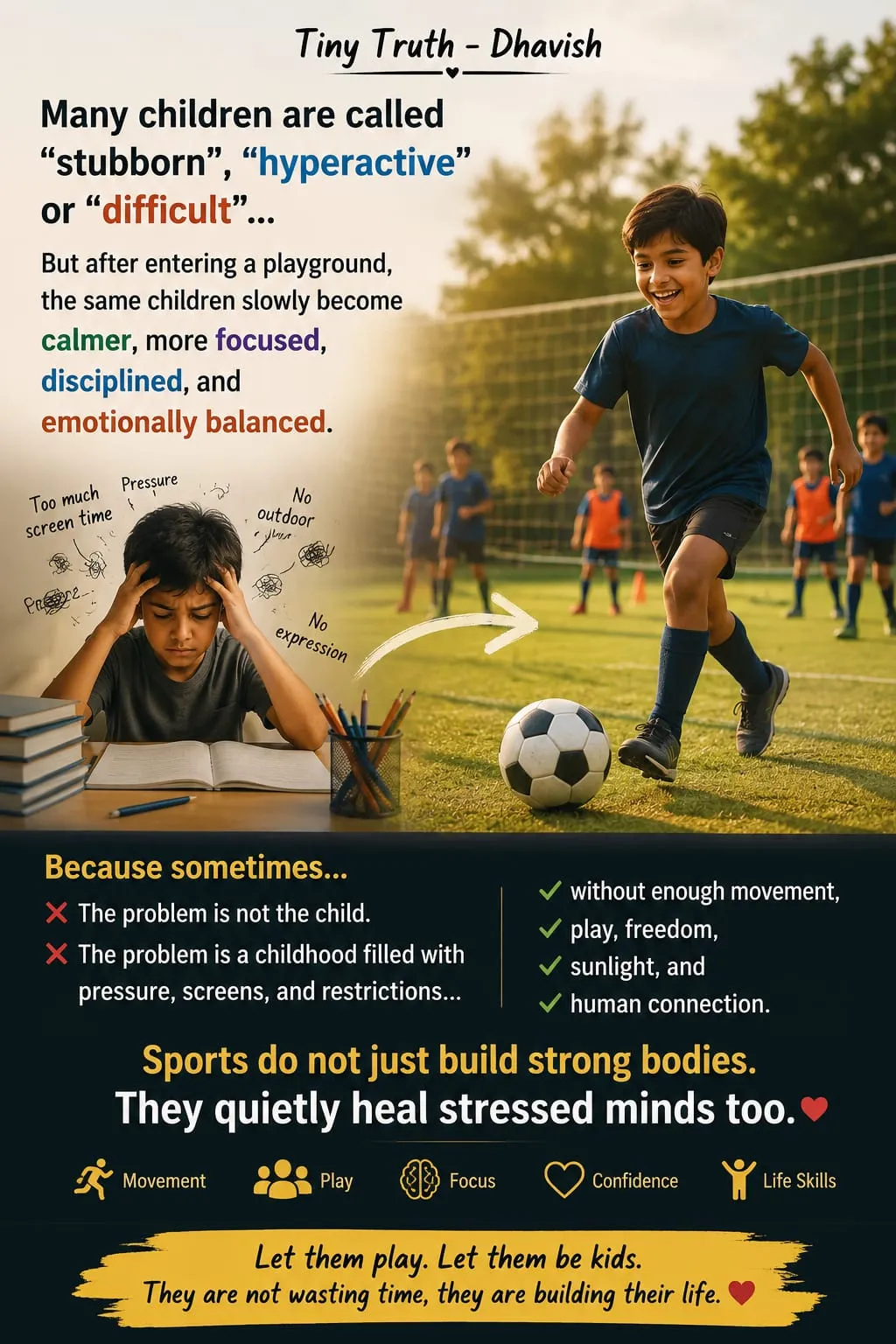
Many children today are not “misbehaving”.
They are emotionally exhausted.
Behind anger, stubbornness, hyperactivity, poor focus, mood swings, or screen addiction, there is often something deeper happening silently inside a child’s mind.
Children today are growing up with academic pressure, busy routines, less outdoor play, excessive screen time, emotional isolation, and very little real freedom to run, laugh, explore, and feel alive simply.
And slowly, childhood itself is changing.
Many children are losing:
Movement,
Sunlight,
Teamwork,
Real conversations,
Physical play,
Emotional release and connection with nature.
As a result, stress is building up inside children in ways adults often fail to notice.
Sometimes the child does not need more scolding.
Sometimes the child does not need another lecture.
Sometimes, the child simply needs a playground. Because sports are not just games for children. Sometimes, they quietly become therapy for a stressed mind.
The Hidden Emotional Stress Children Carry Today
Childhood may look easier from the outside, but many children today are mentally and emotionally overloaded.
A child may not openly say:
“I feel stressed.”
“I feel pressured.”
“I feel emotionally tired.”
Instead, those emotions appear through behavior.
Some children become:
Stubborn,
Angry,
Distracted,
Emotionally sensitive,
Restless,
Aggressive,
Anxious,
Disconnected from studies and relationships.
Many parents immediately think the child has an attitude problem. But many times, the real problem is emotional overload without healthy release.
Children are naturally designed to move, explore, play, interact, and express energy physically.
When movement disappears, emotional pressure starts building silently inside the body and mind.
This is one of the biggest reasons sports are becoming more important than ever before.
Sports Support Psychological Development in Children
Sports do much more than improve physical fitness.
They directly support brain function, emotional regulation, concentration, and mental well-being.
When children actively play, run, jump, or participate in sports, the brain releases natural chemicals like endorphins and dopamine.
These chemicals help:
Reduce stress,
Improve mood,
Increase focus,
Lower anxiety,
Create emotional balance.
This is why many children behave more calmly and positively after outdoor activities.
Physical movement helps children release stored emotions naturally.
A child who cannot explain feelings through words may unknowingly release frustration, stress, or sadness while playing.
Sports often become a healthy emotional outlet.
Not because problems disappear…
But movement helps the brain process emotions in a healthier way.
Sports Improve Focus and Concentration
Many children today struggle to sit calmly, focus on studies, or maintain attention for long periods.
Excessive screen exposure, reduced physical activity, and mental overload affect concentration levels significantly.
Sports help improve:
Attention span,
Memory,
Discipline,
Mental alertness,
Decision-making ability.
After physical activity, the brain becomes more active and refreshed.
A child who gets regular movement often learns better compared to a child who remains mentally exhausted throughout the day.
Children are not machines designed only for sitting, memorising, and performing.
Their brains need movement to function properly.
Emotional Development Through Sports
One of the most powerful benefits of sports is emotional growth. Sports naturally teach children how to handle emotions in real-life situations.
Through games and activities, children slowly learn:
Patience,
Self-control,
Teamwork,
Resilience,
Discipline,
Emotional maturity.
Most importantly, sports teach children how to handle failure. A child who loses a game learns:
Losing is temporary.
Mistakes are part of growth.
Improvement needs practice.
Failure does not define self-worth.
These lessons become extremely valuable later in life.
Children who never experience failure often struggle emotionally when life becomes difficult.
But children involved in sports usually develop stronger coping abilities because they learn to rise again after setbacks.
That emotional strength becomes one of the greatest life skills.
Sports Build Confidence Naturally
Confidence cannot be built only through motivational speeches or academic success.
Real confidence develops through experiences.
When children:
Learn a new skill,
Improve gradually,
Participate in competitions,
Overcome fear,
Achieve personal goals,
They slowly begin believing in themselves.
Sports create healthy self-confidence because children experience progress directly.
A child who once felt shy may become expressive.
A child who feared failure may become courageous.
A child with low self-esteem may slowly feel capable and valued.
This confidence later reflects in academics, communication, relationships, and decision-making.
Physical Development Is Equally Important
Modern lifestyles are making many children physically inactive.
Prolonged screen time, indoor lifestyles, and reduced outdoor activities are rapidly affecting children’s health.
Sports help children:
Build stronger muscles and bones,
Improve flexibility and stamina,
Maintain healthy body weight,
Strengthen immunity,
Improve sleep quality,
Increase overall energy levels.
Outdoor sports also expose children to sunlight, which supports healthy growth and brain development.
Children who move regularly often feel fresher, happier, and more emotionally stable.
The body and mind are deeply connected. When physical health improves, emotional well-being often improves too.
Sports Teach Real-Life Social Skills
Today, many children spend more time with devices than with people. As a result, communication skills and emotional connection are slowly weakening.
Sports bring children back into real human interaction. On a playground, children learn:
Cooperation,
Communication,
Leadership,
Empathy,
Respect,
Teamwork,
Conflict resolution.
They learn how to support others, adjust to different personalities, and work together toward a common goal.
These social skills cannot be fully learned through screens or textbooks. They develop naturally through real experiences.
Not Every Child Needs to Become an Athlete
This is important for parents to understand. The purpose of sports is not only to produce champions or professional players.
Every child does not need medals or trophies. Some children simply need sports for emotional healing and mental balance.
Some children need sports:
Reduce stress,
Feel emotionally lighter,
Improve confidence,
Manage anger,
Improve focus,
Simply to feel happy again.
Sometimes, one hour on a playground does more for a child’s mental health than hours of pressure and correction.
Parents and Teachers Must Change the Way They See Sports
In many homes and schools, sports are still treated as “extra activities” or rewards given only after studies.
But physical activity is not separate from education. It is a necessary part of healthy childhood development.
A mentally exhausted child cannot learn effectively, no matter how intelligent they are.
Children need balance:
Learning and movement,
Discipline and freedom,
Structure and creativity,
Studies and play.
When this balance is missing, emotional stress slowly increases. Parents and teachers must understand that sports are not a waste of time.
In many cases, sports protect a child’s emotional health.
Meaningful Conclusion
A playground is not just a place where children play games. Sometimes, it quietly becomes the following:
A stress reliever,
A confidence builder,
An emotional outlet,
A teacher of discipline,
A place of friendship,
A healing space for a growing mind.
In today’s fast-moving and emotionally demanding world, children need more than academic success.
They need emotional strength, mental balance, healthy confidence, human connection, and the freedom to feel like children.
And sports help build all of these naturally. Because sometimes the child is not “difficult”. Sometimes the child is emotionally overloaded and physically restricted.
And what looks like “bad behaviour” may actually be a silent request for movement, freedom, connection, and emotional release.
Sometimes, the best therapy for a child is not another lecture.
It is sunlight, open space, a playground, a team, movement, laughter, and the simple freedom to play.