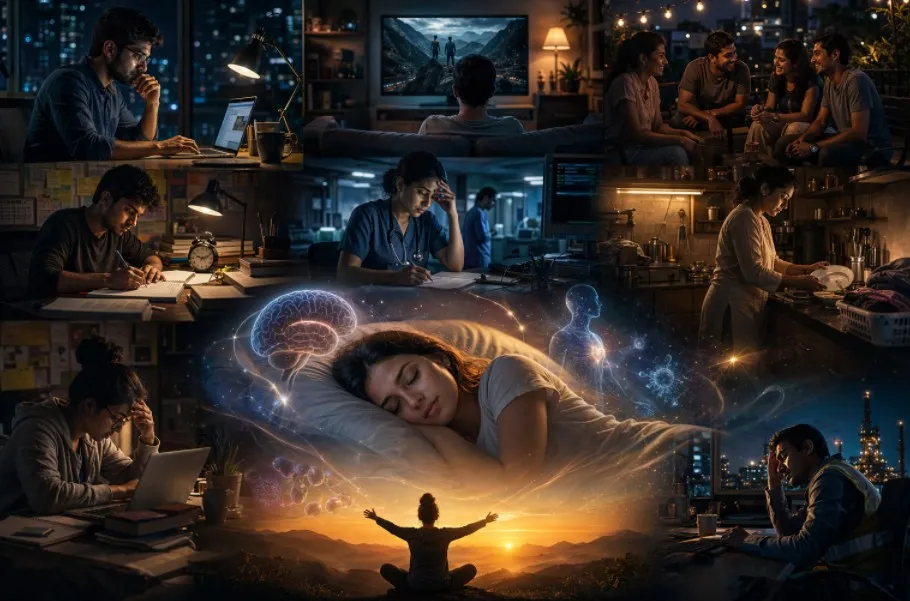
Mobile Addiction in Adults: The Silent Habit Destroying Focus, Sleep, Relationships, and Emotional Balance
Are you really using your phone or is your phone quietly controlling your thoughts, emotions, and daily life without your knowledge?
By Shwetha B R | 24, May, 2026 05:19 AM
You wake up in the morning and immediately check your phone. Just for a few minutes. But those few minutes quietly become thirty minutes, sometimes one hour.
Before your day even begins, your mind is already filled with reels, messages, news, notifications, videos, and endless information.
Then throughout the day, something inside you starts changing.
You become irritated for small reasons. Children’s noise starts disturbing you. Conversations feel exhausting. Your patience becomes weaker. Your sleep feels incomplete. Your mind feels tired even without doing much work.
Still, you tell yourself, “I’m fine.” “Nothing is happening to me.” “Everyone uses mobile.”
But are you really fine?
Or has mobile addiction silently become part of your personality, emotions, and daily lifestyle?
This article is not written to judge anyone. It is written to hold a mirror in front of all of us. Because some of the biggest problems in life do not enter loudly. They enter quietly through small daily habits repeated every single day.
Is Your Phone Quietly Taking Control of Your Life?
Ask yourself honestly.
Can you sit peacefully for one hour without touching your phone?
Can you eat one full meal without checking notifications?
Can you spend time with your children without looking at your screen every few minutes?
Do you open social media for five minutes and come out after one hour without realising it?
Do you feel restless when your battery is low?
Do you check your phone even when there is no notification?
Do you sleep late because of scrolling and wake up mentally tired the next morning?
Do you feel irritated when someone interrupts your screen time?
Do you notice yourself reacting emotionally for silly reasons these days?
Do you keep saying, “I’m just relaxing,” while your mind feels more exhausted every day?
These questions may look simple. But they reveal something deeper.
Many people today are no longer using phones consciously. They are using them automatically. Without realising it, the phone has become the first thing they touch in the morning and the last thing they hold before sleeping.
The Most Dangerous Addictions Look Normal
When people hear the word 'addiction', they think about alcohol, smoking, or drugs. But today, one of the strongest addictions is socially accepted because everyone is doing it.
Mobile addiction does not look dangerous. That is exactly why it becomes dangerous.
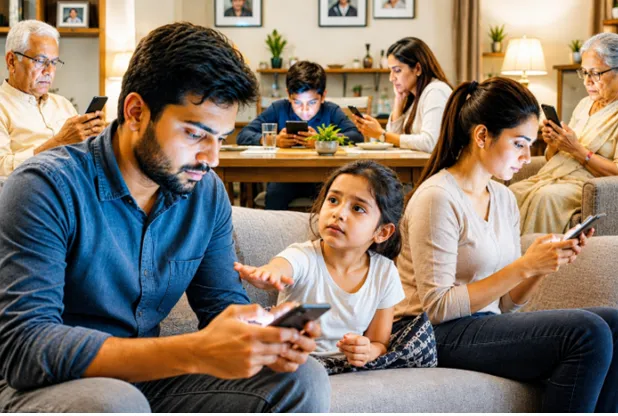
A family sitting together while everyone stares at separate screens has become normal. Parents scrolling while children wait for attention has become normal. Sleeping with phones in hand has become normal. Being unable to focus has become normal. Feeling mentally exhausted all the time has become normal.
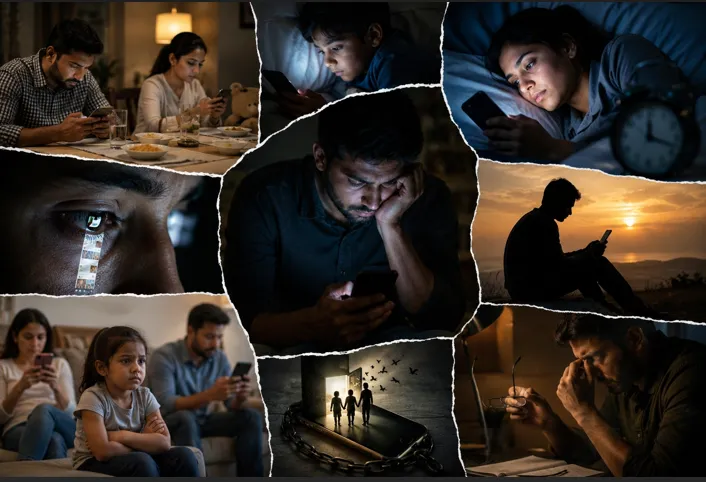
But normal does not always mean healthy.
Sometimes unhealthy lifestyles become so common that people stop questioning them completely.
Your Brain Is Being Trained Every Day
This is not simply about bad habits. There is real science behind mobile addiction.
Every notification, reel, like, message, or short video releases dopamine in the brain. Dopamine is the chemical connected to pleasure and reward. The brain starts craving that stimulation again and again.
That is why you unlock your phone without any reason. That is why one reel turns into endless scrolling. That is why silence feels uncomfortable. That is why your mind constantly searches for something new to watch, read, or check.
Over time, the brain loses its ability to stay calm naturally. Simple moments begin to feel boring because the brain becomes addicted to fast stimulation.
A peaceful conversation feels slow. Waiting feels irritating. Silence feels uncomfortable. And without noticing it, emotional balance starts becoming weaker.
A Painful Reality Many Families Are Living Today
Imagine this scene.
A child is excited to share something about school. The child keeps talking with happiness. But the parent nods without listening properly because their eyes are fixed on the mobile screen.
After a few seconds, the child becomes quiet.
This scene is happening in many homes every single day.
Not because parents do not love their children. But because attention is getting stolen little by little.
How many times have children said, “Listen to me" while adults continued scrolling without even realising it?
Children may forget expensive gifts. But they never forget feeling ignored.
One of the saddest realities today is this: many families are physically together but emotionally disconnected. Not because love is missing, but because screens are consuming attention, conversations, and presence.
Why Are People Becoming More Irritated Nowadays?
Have you noticed how quickly people react emotionally today?
Small delays create frustration. Children’s sounds feel disturbing. Simple conversations feel exhausting. Patience is reducing everywhere.
Stress is one reason. But overstimulation is another hidden reason people rarely talk about.
(Overstimulation happens when your brain gets more sights, sounds, or activities than it can handle, causing you to feel overwhelmed, stressed, or exhausted.)
The brain today rarely gets rest. From morning till night, it continuously consumes reels, videos, messages, advertisements, news, arguments, and endless content.
The mind never becomes truly quiet. And a mind that never rests becomes emotionally tired.
That is why many people lose patience quickly, struggle to focus, overreact emotionally, feel mentally exhausted, and remain restless even while resting.
Sleep Is Being Damaged More Than People Realize
Many people sleep for seven or eight hours but still wake up tired.
Why?
Because the brain is not getting proper recovery.
Late-night scrolling affects melatonin, the hormone responsible for deep sleep. Blue light from screens keeps the brain active even when the body is lying down.
(Melatonin is a natural hormone produced by the pineal gland in the brain. It regulates the body's internal sleep-wake cycle.
That is why many people wake up feeling heavy, struggle to concentrate, feel lazy in the morning, and remain mentally drained throughout the day.
The body may be resting. But the mind is still running.
Mobile Addiction Is Also Changing Personality
This is the part most people fail to notice.
Mobile addiction does not only waste time. It quietly changes behaviour.
People become less patient, more distracted, emotionally unavailable, mentally restless, and disconnected from real life.
Even happiness changes.
Simple moments no longer feel enough. The mind constantly wants more stimulation, more entertainment, more scrolling. And eventually, ordinary life stops feeling satisfying.
The Biggest Lie People Tell Themselves
“I can stop anytime.”
“Nothing is happening to me.”
“Everyone uses phones.”
But if something is affecting your sleep, focus, patience, relationships, emotional health, and ability to stay mentally calm, then it is already affecting your life deeply.
The problem is not the mobile phone itself. The real problem begins when the mind loses control over its own attention.
Small Habits Quietly Create Big Damage
No one destroys emotional balance in one day.
It happens through repeated small habits.
One more hour of scrolling at night. One more distracted conversation. One more ignored family moment. One more bowl of food with the phone in hand. One more morning beginning with noise instead of calmness.
And after years, people wonder why they feel mentally exhausted, emotionally disconnected, and internally restless.
Daily habits quietly shape lifestyle. And lifestyle eventually shapes personality, relationships, health, and the quality of life itself.
So What Is the Solution?
The solution is not throwing away your phone.
Technology is useful when used consciously. But life should not become controlled by a screen.
Start with small changes.
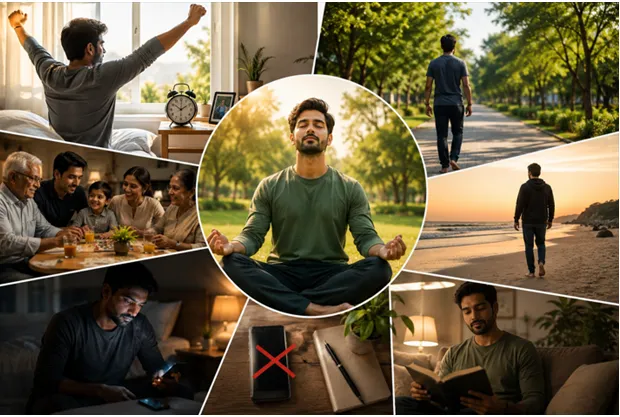
Do not touch your phone immediately after waking up. Keep some screen-free time every day. Avoid scrolling before sleep. Spend time with family without distractions. Walk sometimes without carrying your phone. Observe honestly how many times your hand reaches for the phone unconsciously.
Most importantly, learn to sit quietly without constant stimulation.
Because many people are not addicted only to mobile phones. They are addicted to escaping silence, stress, loneliness, emotions, and their own thoughts.
Final Thoughts:
The real danger of mobile addiction is not only wasted time. You are slowly becoming unavailable for your own life while believing everything is normal.
One day, children grow up, parents grow old, and relationships change. But many people are so busy looking at screens that they stop truly experiencing the people sitting beside them.
At the end of life, nobody regrets not watching enough reels. People regret the conversations they missed, the moments they ignored, and the people who wanted their attention while they were looking somewhere else.
So ask yourself honestly:
While holding your phone every day, are you slowly missing your own life?
Before you put your phone down today, ask yourself honestly:
How many beautiful moments, meaningful conversations, and precious memories are you missing, while looking at a screen?