Are We Raising Smart Children… or Over Dependent Children?
The hidden psychological impact of excessive comfort, mobile dependency, and unlimited facilities on today’s children
By Shwetha B R | 18, May, 2026 08:53 AM
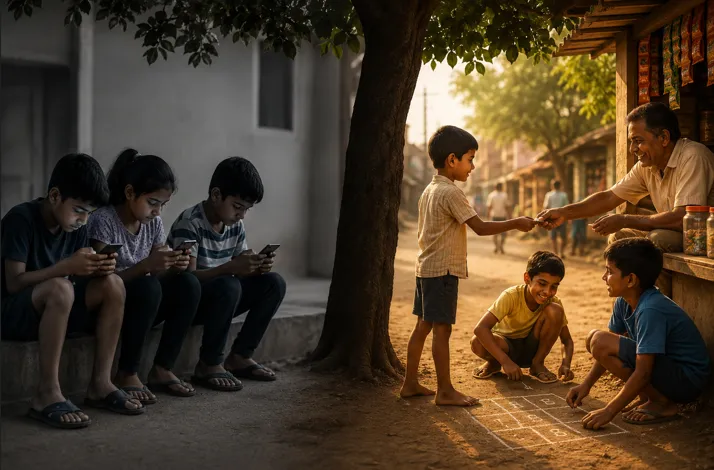
“Somewhere between screens and convenience, children are slowly missing the simple experiences that once taught us how to live.”
Technology Made Life Easier… But Also More Dependent:
It’s strange how life has changed so fast.
Today we can book tickets within seconds, pay money without touching cash, order food without stepping outside, and buy almost everything through a mobile phone.
Somewhere, it is good.
Technology truly made many things easier.
But slowly, without realising it, many of us have become dependent on smartphones even for the smallest things.
And children are growing up watching this lifestyle every single day.
Earlier, people used mobiles when necessary.
Now many people cannot stay without checking their phones for even a few minutes.
While eating a mobile.
While travelling mobile.
Before sleeping, mobile.
Immediately after waking up, mobile.
Even adults are unknowingly addicted.
And honestly, the biggest problem is not only screen time.
It is the small real-life experiences we are losing because of excessive dependency and unlimited comfort.
The childhood we had taught us life without us realising it:
Most of our parents and elders spent their lives without smartphones.
Still, they handled responsibilities, travel, money, shopping, relationships, and family beautifully.
They purchased things by paying cash.
They collected exact change carefully.
They booked bus or train tickets directly.
They spoke with vendors, neighbours, conductors, and strangers naturally.
Those small conversations may look ordinary now.
But they created:
- connection
- confidence
- patience
- communication skills
- practical understanding of life
Today many people are connected online… but disconnected from people around them.
Small Practical Experiences Built Confidence:
When we were children, our parents used to send us to nearby petty shops to buy small things.
After returning home, they would ask:
“How much did you purchase?”
“How much money did you give?”
“How much balance did you get back?”
At that age, we never realised those moments were teaching us life skills.
Without calculators or apps, we slowly learnt:
- Practical mathematics
- Money value
- Communication
- Confidence
- Responsibility
We learned how buying and selling actually works.
We learnt bargaining too.
It may sound silly now, but bargaining taught us confidence and social interaction.
We learned to speak with people naturally.
We learned patience while standing in queues.
We learnt to tell time by seeing analog clocks.
Those were not “special parenting techniques".
That was simply life.
And life itself was teaching us practical intelligence.
Today’s Children Are Growing Up Differently
Now just compare your childhood with your children’s childhood.
Many children today:
- Don’t know small-money transactions.
- Depend completely on digital payments.
- Struggle to read analog clocks.
- Hesitate to communicate with strangers.
- Expect instant comfort everywhere.
Even during a one-hour journey, some children purchase snacks worth ₹200–₹300.
That too, mostly unhealthy snacks.
Is it really necessary?
Or are we slowly creating habits without boundaries?
Today:
- Toys have no limit
- Shopping has no limit
- Pocket money has no limit
- Demands have no limit
Many children receive things immediately before even understanding their value.
And slowly, patience disappears.
Earlier Restrictions Had Meaning:
When we were young, snacks were occasional treats.
New dresses came mostly during festivals, fairs, birthdays, or special occasions.
Even then, our parents focused more on quality than brands.
They were not trying to give a luxurious childhood.
They were trying to teach balance.
At that time, many restrictions felt difficult.
But today, when we look back, we understand something important:
Those limits taught us:
- Patience
- Gratitude
- Money value
- Emotional control
- Adjustment
- Discipline
Now many children are growing up with comfort everywhere, but very little emotional restriction.
The Hidden Psychological Impact of Excessive Comfort
Psychologically, when children get everything instantly, they slowly lose the ability to wait, adjust, and handle disappointment.
And real life does not give everything instantly.
That is why many children today
- Become irritated very quickly.
- Lose patience easily.
- Feel bored constantly.
- Struggle with emotional control.
- Depend heavily on entertainment.
The brain slowly becomes used to constant stimulation and instant satisfaction.
Children do not become emotionally strong only through love and facilities.
They also need:
- Boundaries.
- Responsibilities.
- Practical exposure.
- Patience.
- Delayed gratification.
These experiences help children face real life confidently later on.
Adults Are Also Losing Small Human Connections:
This problem is not only with children.
Even adults are changing unknowingly.
Today many people:
- Cannot sit quietly without scrolling.
- Use phones during conversations.
- Check notifications repeatedly.
- Travel without observing surroundings.
- Depend on GPS even for familiar places.
Earlier, people spoke while travelling.
Now most people scroll silently.
Earlier, families sat together and talked.
Now many families sit together physically while everyone is mentally inside different screens.
Slowly, convenience is replacing connection.
Children Learn More From Our Lifestyle Than Our Advice
The biggest truth is this:
Children copy what they see more than what they hear.
If parents constantly use phones, children naturally believe this is normal life.
Later we blame children for screen addiction.
But many times, children are simply following the environment around them.
Facilities Are Good… But boundaries are important.
This article is not against technology.
Technology is useful.
Digital payments save time.
Online booking is helpful.
Smartphones are important in many situations.
But excessive dependency slowly removes practical life experiences from children.
Children should know how to:
- Handle cash occasionally.
- Calculate balance money.
- Speak confidently with people.
- Purchase basic things independently.
- Control unnecessary spending.
- Wait patiently without constant entertainment.
These may look like small skills.
But they slowly build emotional strength, confidence, and practical intelligence.
What Parents Can Do Slowly
- Parents do not need to become extremely strict suddenly.
- That usually creates resistance.
- Small changes are enough.
- Start slowly.
- Reduce unnecessary screen dependency little by little.
- Encourage real conversations during travel.
- Give controlled pocket money.
- Allow children to buy small things independently.
- Teach them the value of money practically, not only through lectures.
- Most importantly, explain the reason behind restrictions. Otherwise, children may compare themselves with other families who provide unlimited freedom and unnecessary luxury.
- A good upbringing should not feel like punishment.
- It should slowly become part of a lifestyle.
Maybe Children Need Balance More Than Unlimited Comfort
Every parent wants to give their children the best life possible.
There is nothing wrong in providing good facilities, good education, good clothes, or a comfortable life.
But somewhere, in the middle of screens, instant shopping, unlimited entertainment, and excessive comfort, many small life lessons are disappearing silently.
- The ability to wait.
- The happiness of simple things.
- The confidence to speak with people.
- The understanding of money value.
- The patience to adjust.
- The beauty of real human connection.
Maybe children do not need a difficult life.
But they also should not grow up believing life must always be instant, easy, and unlimited.
Because one day, real life will test them beyond screens, beyond comfort, and beyond luxury.
And at that moment, practical experience, emotional strength, patience, discipline, and human connection will matter far more than digital convenience.
Technology should help life.
It should not slowly replace life itself.
Think about it.
“Technology should make life easier, not slowly disconnect us from real life, practical wisdom, and human relationships.”

Did this article connect with your childhood memories or parenting experiences?
Do you feel children today are becoming more dependent on screens and comfort?
Share your real-life experiences and honest thoughts in the comments. Your opinions help me understand practical realities better and write more meaningful content for Dhavish.