Place Value - The Hidden Power That Makes Numbers Meaningful
A child may read numbers… but without place value, they don’t truly understand them.
By Shwetha B R | 01, Apr, 2026 01:24 PM
When Knowing Numbers Isn't the Same as Understanding Them
Most children can confidently say numbers.
"45... 54... 100... 205..."
It sounds impressive.
But ask a simple question:
"Which number is bigger—45 or 54? And why?"
Some children answer correctly.
Some hesitate.
Some simply guess.
The real concern is not whether they choose the right answer.
The important question is the following:
Do they understand why one number is bigger than the other?
This is where the foundation of mathematics is either built or broken.
Many children learn to read numbers, write numbers, and even solve problems without truly understanding what those numbers represent. If they keep memorising, everything appears fine. But when mathematics becomes slightly more advanced, confusion begins to surface.
One small concept lies at the heart of this problem—place value.
Without understanding place value, numbers become random symbols.
Once children understand it, numbers begin to make sense.
The Hidden Meaning Behind Every Digit
Place value simply means this:
The position of a digit decides its value.
Let's look at a simple example.
23
The digit 2 is in the tens place.
So, it represents 20.
The digit 3 is in the ones place.
So, it represents 3.
Together,
23 = 20 + 3
Now look at another number.
32
The digits are the same.
But now 3 is in the tens place.
So, it represents 30.
The 2 is in the ones place.
So, it represents 2.
Therefore,
32 = 30 + 2
The digits have not changed.
Only their positions have changed.
Yet the value of the entire number becomes completely different.
That is the power of place value.
Every number tells a story, and each digit plays a unique role. Change the position of a digit, and the story changes completely.
Why Children Struggle Even After Learning Numbers
Let's be honest.
Many children are taught to memorise place values rather than understand them.
They practise worksheets.
They fill in blanks.
They copy examples.
They prepare for tests.
But very few are encouraged to ask questions like the following:
- Why does the position of a digit matter?
- How are numbers formed?
- What happens when we change the position of a digit?
Without these conversations, children often remember procedures but fail to understand the idea behind them.
As a result, we see common mistakes such as the following:
- Writing 205 as 25.
- Reading 1002 as 102.
- Confusing tens and ones.
- Ignoring the importance of zero.
These mistakes are not signs of poor intelligence.
They simply show that the child has not yet understood the structure of numbers.
When place value is unclear, numbers lose their meaning.
Turning Everyday Experiences into Mathematics Lessons
Children learn best when mathematics feels connected to their everyday lives.
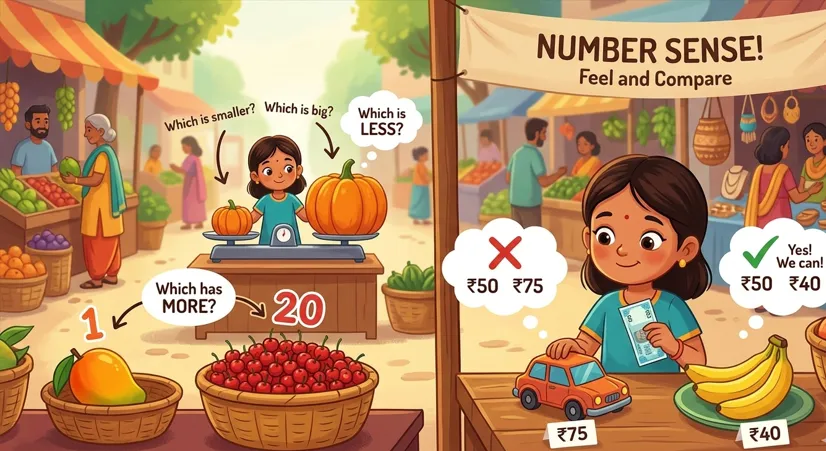
Think about money.
A ₹10 note is not the same as a ₹1 coin.
A ₹100 note carries greater value – not because it is physically larger, but because of what it represents.
The same idea applies to numbers.
Or think about bundles of sticks.
One stick represents 1.
One bundle of 10 sticks represents 10.
Ten such bundles represent 100.
Suddenly, place value becomes something children can see and understand.
Mathematics becomes meaningful when children connect it with real-life experiences instead of seeing it as a page full of symbols.
One Simple Habit That Builds Strong Number Sense
One small habit can make a remarkable difference.
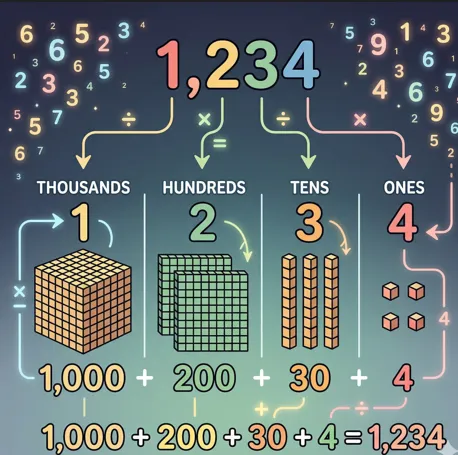
Encourage children to break every number into parts.
For example:
47 = 40 + 7
105 = 100 + 0 + 5
230 = 200 + 30 + 0
This simple practice helps children understand how numbers are built.
It also prepares them for addition, subtraction, multiplication, division, estimation, and even algebra in later years.
Children who understand number composition develop stronger mathematical thinking because they no longer memorise numbers—they understand them.
Small Mistakes Today, Bigger Challenges Tomorrow
Many early mistakes appear harmless.
Parents and teachers often overlook them because the child eventually arrives at the correct answer.
But these small misunderstandings gradually grow into larger learning difficulties.
Ignoring zeros.
Writing digits in the wrong order.
Reading numbers without understanding their value.
Confusing hundreds, tens, and ones.
These mistakes can affect almost every future mathematics topic – from basic calculations and fractions to decimals, measurement, and beyond.
A strong foundation today prevents unnecessary struggles tomorrow.
Helping Children Understand Instead of Memorising
Teaching place value does not require expensive learning materials.
Simple everyday objects are enough.
Use sticks, beads, bottle caps, coins, or pencils to create groups of ten and one hundred.
Ask children questions that make them think rather than memorise.
- "What does this digit represent?"
- "Why is this number bigger?"
- "What happens if we swap these two digits?"
Encourage children to explain their thinking.
When children can explain a concept in their own words, it usually means they truly understand it.
Always remember:
Fast learning without understanding often leads to long-term confusion.
Taking a little more time today can save years of frustration later.
A Simple Truth Every Child Should Remember
"A number is not just what you see – it is what every digit represents."
This simple thought can completely change the way a child looks at mathematics.
Instead of seeing numbers as symbols to memorise, they begin to see patterns, meaning, and logic.
And that is where real learning begins.
Building Strong Foundations, One Digit at a Time
Place value is not just another mathematics chapter.
It is the foundation of the entire number system.
When children truly understand place value:
- Calculations become easier.
- Mistakes reduce naturally.
- Confidence grows with every problem they solve.
- Mathematics begins to feel logical instead of difficult.
The greatest gift we can give a child is not the ability to memorise numbers but the ability to understand them.
Because when children understand why numbers work the way they do, they don't just become better at mathematics – they become better thinkers, better problem-solvers, and more confident learners.
Author's Reflection
Before children solve difficult mathematical problems, they must first understand what a number truly means. Place value may appear to be a small topic, but it quietly supports every calculation they will ever do. When we help children understand this concept with patience and real-life experiences, we are doing much more than teaching mathematics – we are building confidence, logical thinking, and a lifelong love for learning. Sometimes, the strongest foundations are built by giving the smallest concepts the greatest importance.
Thank you for reading this article.