Why Do We Learn Arithmetic, Algebra, and Geometry? The Answer Every Student Deserves to Hear
Mathematics is not just about solving problems on paper -it teaches you how to solve problems in life.
By Shwetha B R | 10, Jul, 2026 05:07 AM
"I'll never use algebra in my life!"
Have you ever heard someone say,
"What's the use of learning algebra?"
"Why should I study geometry?"
"After school, who even uses these formulas?"
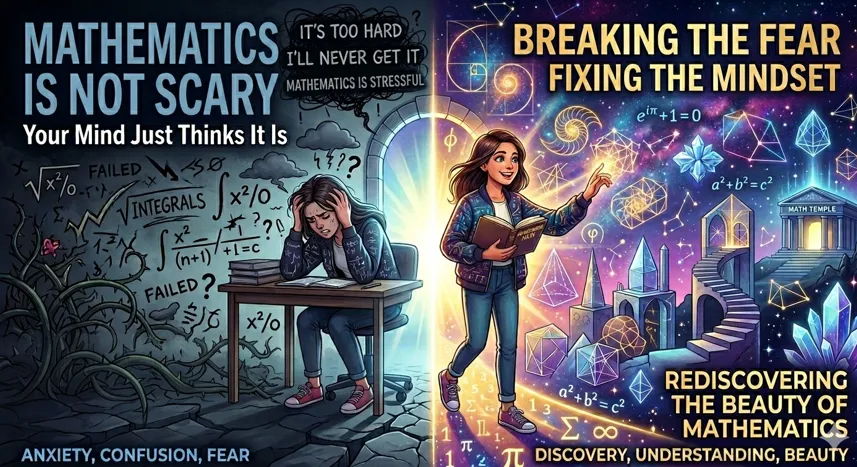
Many students ask these questions because they only see mathematics as a subject filled with numbers, equations, and examinations. They spend hours solving problems but rarely understand why they are learning them.
Imagine teaching someone to drive a car without explaining why they need brakes, mirrors, or seat belts. They may learn to operate the car, but they will never appreciate its importance until they face a real situation.
Mathematics is exactly like that.
It is not just about getting the correct answer. It is about training your brain to think, analyse, and solve problems. Every branch of mathematics develops a different skill that helps you throughout your life.
Let's understand how.
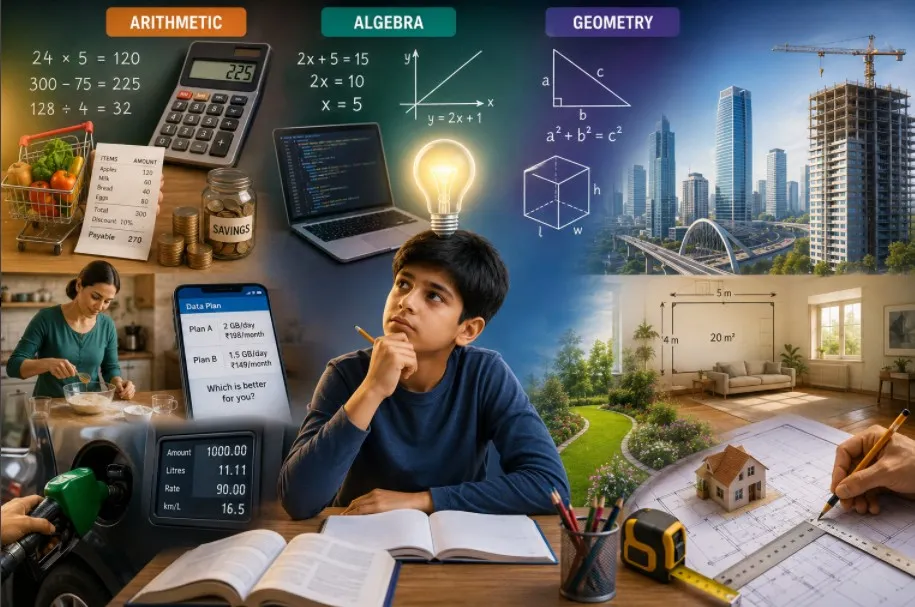
Arithmetic: The Mathematics You Use Every Single Day
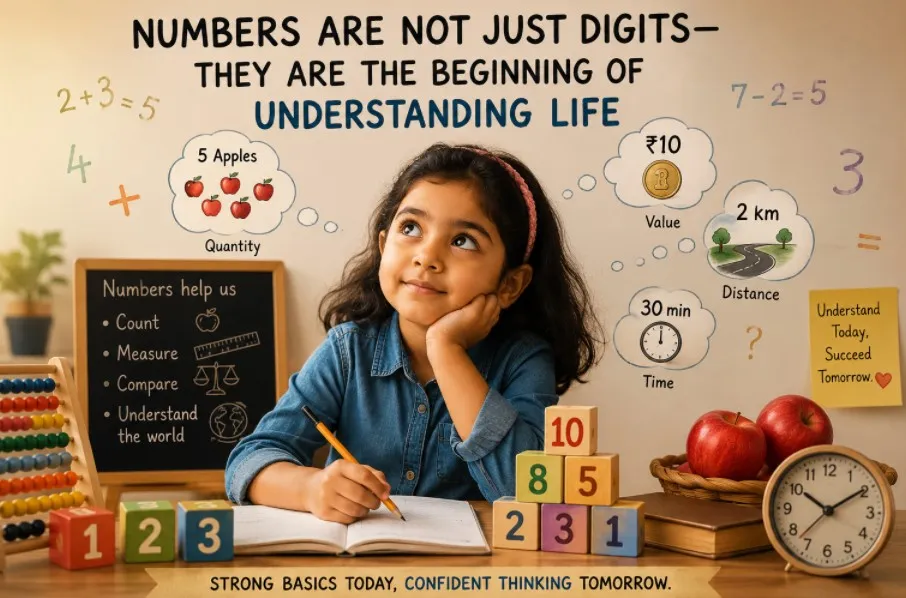
Arithmetic is the first language of mathematics.
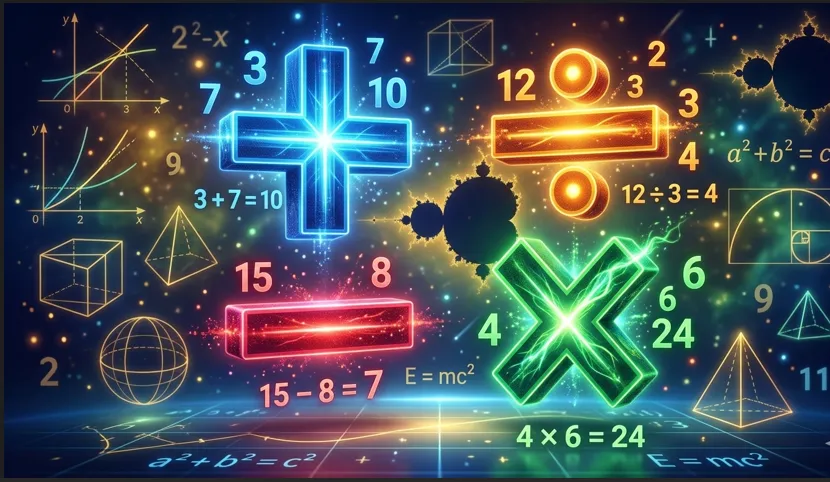
It includes addition, subtraction, multiplication, and division. These may look like simple calculations in school, but they become essential life skills when you grow up.
Imagine you visit a supermarket.
You buy groceries worth ₹2,450. A discount of 20% is offered.
Can you quickly estimate how much you will save?
If you can, that's arithmetic helping you.
Suppose your monthly salary is ₹50,000.
After paying rent, electricity, school fees, fuel, and groceries, you want to save money for your child's education.
How much can you save every month?
Again, arithmetic.
When you cook for ten people instead of four, measure medicine, calculate fuel mileage, divide restaurant bills among friends, or compare online shopping offers, you are using arithmetic.
People who are comfortable with numbers usually make better financial decisions because they understand money instead of guessing.
Arithmetic teaches confidence with numbers.
That confidence stays with you for life.
Algebra: Learning to Solve Problems When You Don't Know Everything
This is where many students lose interest.
They ask,
"Why are there letters instead of numbers?"
The answer is surprisingly simple.
Life rarely gives us all the information.
Sometimes we know the result but not the starting point.
Sometimes we know the destination but not the distance.
Algebra teaches us how to find the missing piece logically.
Imagine you receive your electricity bill.
Last month it was ₹2,800.
This month it is ₹3,400.
You know the fixed charge is ₹500, but you don't know how many extra units you used.
Finding that unknown value is exactly what algebra trains your brain to do.
Suppose you want to buy a laptop costing ₹60,000.
You already have ₹18,000.
If you save the same amount every month, how long will it take?
You don't know the number of months.
That unknown value becomes x.
Algebra helps you find it.
Business owners use algebra while calculating profit.
Scientists use it while conducting research.
Engineers use it while designing machines.
Software developers use it while writing computer programs.
Economists use it while predicting markets.
Even Google Maps uses mathematical algorithms based on algebra to calculate the fastest route.
But perhaps the biggest benefit is psychological.
Algebra teaches your brain not to panic when information is incomplete.
Instead of guessing, you learn to think step by step until the answer appears.
That habit is valuable in every career – and in life itself.
Geometry: Understanding the World Around You
Look around your room.
The walls.
The ceiling.
The windows.
The table.
The mobile phone in your hand.
Nothing exists without shape, size, distance, angle, or measurement.
That is geometry.
Imagine your family wants to paint your house.
Before buying paint, someone must calculate the area of every wall.
Otherwise, you may buy too much paint and waste money – or buy too little and stop halfway through the work.
That's geometry.
Suppose you are buying floor tiles.
Will 50 tiles be enough?
How large is each tile?
What is the total area of your room?
Again, geometry.
Architects depend on geometry to design buildings that stand safely for decades.
Civil engineers use it while constructing bridges.
Interior designers use it while arranging furniture.
Fashion designers use it while creating patterns.
Graphic designers use it while maintaining balance and symmetry.
Even photographers use geometry to compose beautiful pictures.
Geometry trains your brain to think visually and understand space.
It helps you see relationships that are invisible to others.
Mathematics Builds More Than Marks
Many students believe mathematics is only for engineers or scientists.
That is not true.
The greatest gift mathematics gives is not formulas.
It is thinking.
Every mathematical problem teaches patience.
Every solution teaches discipline.
Every mistake teaches correction.
When you solve difficult questions regularly, your brain slowly becomes better at analysing situations instead of reacting emotionally.
That is why people who practise mathematics often become stronger decision-makers.
Why Mathematics Matters More Than Ever Today
We live in a world driven by technology.
Artificial Intelligence.
Robotics.
Computer programming.
Medicine.
Finance.
Space exploration.
Data science.
Cybersecurity.
All these fields are built on mathematics.
Even the apps you use every day – Google Maps, online banking, food delivery apps, YouTube recommendations, and weather forecasting – depend on mathematical calculations happening every second.
The future belongs to people who can think logically and solve problems creatively.
Mathematics develops exactly these abilities.
Mathematics Doesn't Teach Answers. It teaches thinking.
Arithmetic teaches you to manage numbers confidently.
Algebra teaches you to solve problems even when information is missing.
Geometry teaches you to understand the space and structures around you.
Together, they prepare you for something much bigger than examinations.
They prepare you for life.
The next time someone asks,
"What's the use of learning arithmetic, algebra, and geometry?"
Don't simply say,
"Because they're in the syllabus."
Tell them this:
Arithmetic teaches us how to manage life.
Algebra teaches us how to solve life's unknowns.
Geometry teaches us how to understand the world we live in.
And together, they teach us something far more valuable than mathematics – they teach us how to think.
When you learn mathematics with understanding instead of memorisation, it stops being just another school subject. It becomes one of the greatest life skills you will ever develop.